Aventa Home  Aventa Upcoming EventsAventa - Past ConcertsAventa - The EnsembleAventa MusiciansAventa ReviewsAventa - Links

Review of Maxwell Davies?f De Assumtione Beatae Mariae Virginis Review of Histoire du Soldat


Life on the (Cutting) Edge

Müge Büyükçelen, violin
Aventa Ensemble
Bill Linwood, conductor
Phillip T Young Recital Hall
November 15, 2009

By Deryk Barker (Music in Victoria)


"You would not think to look at him / But he was famous long ago / For playing the electric violin / On Desolation Row."

While not making any comparisons between the expanded Aventa Ensemble and the bizarre cast of characters who inhabit Bob Dylan's fictitious street, nor between soloist Müge Büyükçelen and Dylan's "Einstein disguised as Robin Hood", there was undoubtedly a touch of the eclectic about Yannick Plamondon's La Fenêtre II, an Aventa commission receiving its first performance on Sunday night.

Scored for solo electric violin (the electricity is for amplification rather than effects), strings (two violins, viola, cello and doublebass), brass (two each of horns, trumpets and trombones), piano and a large battery of percussions, Plamondon's new concerto made an immediate impact - as did Büyükçelen's remarkable playing.

Although there were passages which occasionally summoned up other composers (Stravinsky in the opening section, Copland at the close) these influences are thoroughly absorbed into a work which grabbed the attention from its opening whiplash chords and never once let up.

Büyükçelen has never impressed more than she did here, producing a far more attractive tone than one might have expected from the electronics, displaying a formidable rhtymic vitality in the quicker music and a delicious lyricism (with, at times, a huge vibrato) in the slower.

My only previous encounter with Plamondon's music (almost four years ago, also at an Aventa concert) left me somewhat ambivalent; that ambivalence was swept away on Sunday night. La Fenêtre II is a tremendously exciting and involving piece and I cannot imagine a more idiomatic or persuasive performance.

There was just one aspect of the music which, for me, did not work. Towards the close, percussionist Corey Rae began striking what looked suspiciously like one of those metal covers you sometimes see covering plates of food in restaurants. It made a very unsatisfying sound (which I personally would render as "thunk") which did not seem quite to fit.

James Beckwith Maxwell's intueri, which opened the programme, was another immediately attractive - albeit perhaps not in the conventional sense of the word - piece.

Its most memorable music was probably in the two quick triple-time sections - dammit, I am going to call them waltzes, because that is how they felt - which were intense, loud (oh yes) and marvellously engaging.

There was also a lengthy piano solo with much tuned percussion accompanying, interesting antiphonal brass effects and much more. This was music which did not even come close to outstaying its welcome.

George Benjamin's At First Light was both the oldest work on the programme (dating from 1982, by Aventa's standards this is almost historical) and the toughest nut to crack, alternating, as it did, between passages of luminous beauty and others of earsplitting busy-ness, with the occasional texture which reminded one of Benjamin's teacher, Olivier Messiaen.

All of this music - of varying difficulty for the listener, of almost unrelenting difficulty for the performers - was played with an almost frightening accuracy, despite the presence of at least half a dozen non-regular members of the ensemble.

And, it almost goes without saying, Bill Linwood directed performances which not only hit all the notes, but also - by turns - excited, entranced and even danced.

Magic.

Aventa in Copenhagen

Athelas Festival
PLEX, Copenhagen, June 15, 2009
A Ruders celebration!

Aventa took the music of Poul Ruders on tour with concerts in New York City and Copenhagen. No stranger to the music of Poul Ruders, Aventa presented the U.S. premiere of "Abysm" at Scandinavia House in 2006. The 2009 tour featured his "Horn Trio", a virtuoso tour de force for violin, horn and piano in New York City, and "Abysm" and "Four Dances in One Movement" in Copenhagen.

" Paul Ruders' exaggerated chamber music received a hot reception.

There hung a couple of friendly, but certain and a little intimidating eyes on the end wall. A gigantic portrait with a wry smile and lowered shoulders a composer with self-confidence and the courage to consistently go his own way... And the marked face quickly became an exact picture of the original and hugely varied music.

It was day two our of three in Copenhagen Athelas' mini-festival in honour of Ruders with an incredible four ensembles in attendance...One got most of Ruders' manifold chamber music played with enthusiasm and authority all the way round.

Aventa presented Ruders' 2000 work Abysm showing its fascinating consistency through through three varied tone paintings, which at one time did not move out of place and yet imperceptibly underwent dramatic changes." - Henrik Friis, Politiken

Aventa opens Munich's A•DEvantgarde Festival

Aventa Ensemble
Gasteig, Munich, Germany
Sunday June 14, 2009 8:30PM

The 10th A·DEvantgarde Festival opened with a concert dedicated to Canadian New Music. The theme of the 2009 festival is Spielend, meaning playing with ease. With this theme in mind, works from Canadian composers were commissioned including new works from BC composers Rodney Sharman and Jeffrey Ryan, Quebec composer Michel Gonneville and Ontario composer Paul Frehner.

"...it is vital, angular music, which the superb Canadian ensemble Aventa, under the direction of Bill Linwood, implemented with precision" - Sueddeutsche, München

http://www.sueddeutsche.de/75x38P/2930528/Spiel-mit-den-Kontrasten.html

East meets West - Tremblay in Whistler


AVENTA at Squamish Lil'wat Cultural Centre with special guests - the Vancouver Community College Gamelan Ensemble

Jennifer Miller, Whistler Question– At first blush, creating a mix of chamber music together with the sounds of an Indonesian percussion ensemble, and performing it in a First Nations cultural centre, might seem like a random mish-mash of cultures.

But conductor Bill Linwood and others involved in the New Music in New Places series put a lot of thought and careful consideration into the upcoming free performance at Whistler’s Squamish Lil’wat Cultural Centre on March 5.

The program has been crafted to include powerful, complex pieces interspersed with a couple of solo flute songs to “clear the air,” Linwood said. The whole thing will take only an hour and the audience is encouraged to move around during the show. The idea is to make contemporary music accessible and comprehensible to people, as well as finding an environment where the music can be heard differently, he said.

In this case, the circular and glass-encased Istken Hall at the cultural centre will serve as the “stage” for a group of 17 musicians. Linwood said the musicians will be set up within the hall’s central pillars, leaving the outer ring for people to “mill around” during the performance.

Of the concert’s four numbers, the centerpiece is titled “L’Arbre de Borobudur” by Quebec composer Gilles Tremblay. The song, which is inspired by an ancient carving of a tree on a Buddhist temple in Java, blends the sounds of a chamber ensemble and a Sudanese gamelan, or percussion ensemble.

The eastern sounds of the Vancouver Community College (VCC) Gamelan Ensemble include 10 musicians playing gongs, drums and a suling, an Indonesian flute made of bamboo. The contemporary Aventa Ensemble is made up of two harps, French horn, double bass, percussion and an ondes Martenot, which is an early electronic instrument similar to a theremin, he said.

It feels like the two distinct sounds of east and west are at odds at the beginning of the piece, he said, but they become more incorporated as it goes on.

Linwood is co-founder and artistic director for the Aventa Ensemble, which has often featured the music of Gilles Tremblay. The Canadian composer has a “huge” international influence with his music, Linwood said.

Other pieces in the Whistler program include “Fragrance of Cedar,” by Jon Siddal for gamelan ensemble, “Four Directions” by Jennifer Butler for solo flute, and “Turmalin” by Danish composer Anders Nordentoft for solo flute. The concert will be the first performance together with the Aventa Ensemble and VCC Gamelan Ensemble.

Moonlight on the Bluff

Deryk Barker
Music in Victoria
AVENTA at Philip T. Young Recital Hall, Victoria B.C. Sunday April 13, 2008

"When I don't like a piece of music, I make a point of listening to it more closely."

Although French composer Floren Schmitt's are undoubtedly ones to live by, I have to admit that I have rarely felt their need at an Aventa concert.

Sunday's season finale was no exception; while I would not pretend to have enjoyed every piece equally, every one of them had its own special qualities.

Linda Catlin Smith's Knotted Silk opened the programme; with its slow-moving chords and insistent metallic percussion, the work somehow put me in mind of the final movement of Messiaen's Et Exspecto Resurrectionem Mortuorum, although there is little, if any, sonic resemblance. Its progress towards the shimmering close provided a fine hors d'oeuvre to the evening.

Giorgio Magnanensi, as I have remarked before, is a composer with a wonderful sonic imagination and a fine sense of proportion. ethuiá V, for solo horn and electronics, was receiving its first performance.

Darnell Linwood, to whom the work is dedicated, gave a superb performance, in which her tone ranged from a sarcastic, almost savage snarl to a warm noble solemnity, by way of a sort of hiccupping 'whoop' and the sounds that a horn mouthpiece make when connected backwards and blown through. All this was done in conjunction with a typical Magnanensi electronic accompaniment - and I cannot think of a composer working today who has a more persuasive way with electronic sounds.

A most enjoyable piece.

The evening's eponymous music, by Martin Arnold, was slow and gently sensuous, although I gather that I was not the only listener who though a little judicious trimming would have helped.

There is no doubting that there is much beauty in the work, and it will be some time before I forget the lovely duet between glockenspiel and marimba shortly before the end.

James Rolfe's raW opened the second half of the evening. According to the composer it was written by "filtering J.S. Bach's Second Brandenburg Concerto through Bob Marley's War (Bach's first movement), Burning Spear's The Invasion (second movement), and John Philip Sousa's Stars and Stripes Forever (third movement)."

The result is a lively, engaging and frequently hilarious work. Occasionally (very) a hint of Bach came through, but the abiding impression is of fiendishly difficult syncopated phrases of minimal length, synchronised with whiplash precision and boundless energy.

The programme concluded with Anders Nordentoft's Hymne. its first movement was mostly slow-moving chords, leading to an impressive climax. The other movement was more dramatic, from its opening gesture it became more and more agitated (and louder), although the last sound heard was the dying resonance of the piano.

Like the other works I have heard by Nordentoft, Hymne has moments of apparently conventionality interspersed with ore obviously "contemporary" music. But Nordentoft's vision welds these disparate elements into a satisfying whole, even if one cannot easily say exactly what the music is "about". He is a major figure.

It has become a truism to say that Bill Linwood and Aventa gave the music the kind of performances their composers must have wished for while writing.

Aventa go from strength to strength.

Poems squeezed from music, and other delights

ELISSA POOLE
From Tuesday's Globe and Mail
February 5, 2008
AVENTA at Philip T. Young Recital Hall, Victoria B.C. Sunday Feb. 3

The week-long Victoria Symphony Orchestra's New Currents Festival ended on Saturday night (an excellent new flute concerto by Victoria composer Anna Hostman was one of the premieres), but the new music continued. On Sunday, Aventa - Victoria's superb contemporary-music ensemble - premiered two substantial new works, one by Michael Oesterle, another by Peter Hatch, both Canadians; pieces by London-based Torontonian Christopher Mayo and Danish composer Hans Abrahamsen completed the program.

A stranger might deduce from this program that the new music of this part of the world and decade has a recognizable stylistic fingerprint. We know better, but Aventa, directed by Bill Linwood, has a knack for putting complementary compositions together. For those of us who think contrast is overrated, their programs are a treat.

Hatch's Dulcian Patterns was the ideal way to warm up this small hall. Strategically placed off-stage players reinforced a small, mixed chamber ensemble on stage for an experience in "surround sound" that was not at all gratuitous. The dulcian in the title refers to the bassoon's Renaissance predecessor, and the bassoon takes a major role (very nicely played by bassoonist Catherine Carignan). But it's not a concerto per se, even though the bassoon's timbre is often a focusing point: The other instruments play at shadowing it, or disguising it with unisons, while the off-stage instruments confuse our confidence about where sounds are coming from and who is actually making them, quickening a parade of bright, fresh sounds in a swirl of sound waves. Hatch channels bits of the past, discreetly: We get stuck, like a stylus on vinyl, at repeated attempts to start a climax reminiscent of Wagner's Tristan; the bassoon inhabits the range of Stravinsky's Rite of Spring for most of one movement, throws out jagged scales that would be at home in contemporary jazz in another; and we pass through Steve Reich, maybe a hint of Claude Vivier.

Oesterle's wonderful Territio Verbalis was inspired by the mathematician and astronomer Johannes Kepler, and his mother's trial for witchcraft (the volatile mix of folk medicine, abrasive personality and greedy neighbours). It might be called a trumpet concerto, but Oesterle, like Hatch, avoids the standard rhetorical pitfalls of that genre. The trumpet speaks most prominently (soloist Louis Ranger made that speech eloquent as well), but all the instruments in this piece talk. Talk is the subject: Hearsay and superstition; polyphonies of gossip and refutation; vicious, sputtered accusations of small ambitus; and lyrical defences with long, mellifluous lines (and all set within a tense, pulsating background of complementary fascination). We don't need the story - music constructs its own integrities - but it does guide our thoughts, to the multiplicity of spoken phrases, the momentum of slander, and the inevitable clash of human mess with abstract order.

Three poems by Gwendolyn MacEwen converge (and carry) Mayo's A Breakfast for Barbarians for 15-piece mixed ensemble, soprano, and narrator: one poem is spoken (Skulls and Drums); one is sung (the title poem); one is wordless (The Death Agony of the Butterfly) but hardly mute, for this poem is the orchestra's. Subjects converge as well: Appetites insatiable for music, for art, for words turned into art. I liked the sense that the poems were being squeezed out of the music, the occasional smear of Berg in the ensemble, and the juxtaposition of hyperbolic vocal line (soprano Heather Pawsey) with the potent, clear, soft-shoe narration (Christopher Butterfield).

The dense, painterly textures of Abrahamsen's Winternacht were often very beautiful, ranging from a pointillist impressionism to an almost monotone abstraction: darkness, with darker corners. One imagines spending one's time as generously with a single painting as one did with each movement: Finding those places of harmony within the crosshatch of detail; following an undulating line until it dissolves.

One also imagines spending more time with Aventa.

Special to The Globe and Mail

First-rate Boulez in the BC capital

OPUS Magazine - WEST NOTES - Elissa Poole
Aventa Ensemble, Bill Linwood, conductor
Phillip T. Young Recital Hall, Victoria
Sunday, November 4

A piece that contains within itself the potential for continuous expansion need never end if we take the word “continuous” at face value. Pierre Boulez takes it close to that, which is why he has so many unfinished compositions on his desk. Consider Dérive II for 11 instruments, which was given its North American premiere by Victoria’s superb Aventa Ensemble under the direction of Bill Linwood this past November. Boulez constructed it from a set of chords derived from the letters of Swiss conductor Paul Sacher’s last name - S (E flat in German) A, C, H (B natural in German), E, and R (or re, which in French is a D), the same six notes he has used as a basis for several other pieces. In other words, Dérive II acknowledges, by its very existence, the idea of continuous expansion. But that’s not all, since this particular piece has been evolving since at least 1988. When Boulez recorded Dérive II in 2002, it was 25 minutes long. This latest version doubles that. We can even imagine - though we do not need to hear it and Boulez, who is 82, may not feel he needs to write it - yet another version twice as long again.

The word dérive in French translates roughly as “drift.” It is tempting to put the title to work, to think of those six pitches (as well as their every timbral manifestation) as having been thrown into a current, where they catch against debris, divide, disperse, and multiply, but “drift” in English hardly captures the white-water speed at which this happens.

Marked trés rapide, Dérive II is exuberantly active music. It also explores – with reference to Ligeti and Nancarrow - the idea of overlapping periodic structures on multiple rhythmic levels. Its surface is never still: There are a couple places only - little more than musical blinks - where the piece stops to grab a breath (Aventa’s excellent percussionists Masako Hockey and Philip Rempel were in constant motion for almost 60 pages of score).

What does adding another 25 minutes contribute our perception of this music? We could say it offers a more encyclopedic picture of the material’s potential (including much new horn writing, beautifully realized by Darnell Linwood), but it wouldn’t embrace what is most remarkable about the expansion. Dérive II, in the 2002 version, has edges. It feels like a piece, a dazzling display of combinatorial ingeniousness, yes, with Boulez’s trademark virtuosity, sensuous appeal and fabulous abstraction, but, in the end, still “only” a piece. Its more recent incarnation, however, envelops listener (and player) in a highly concentrated conceptual process that is absolutely fluid. We too, are wondrously adrift, and at the risk of sounding New Age, it alters the parameters of the listening experience. Listen to Dérive II, 2007, and you know that there is no limit to “continual expansion.” You’ve had a glimpse of infinity, and lo and behold, it’s a nice place to be.

Dérive II was not the only piece on the program, but it certainly overshadowed the other two - Gregory Lee Newsome’s lulling in medias res and Kaija Saariaho’s Lichtbogen. By no means a minor work, Lichtbogen (inspired by the Northern Lights and superficially reminiscent, in its languorous glide and shifting timbres, of Debussy’s Nuages) was a well-chosen counterpart to the Boulez. The transformation of material, the supple transitions from one frame to another, and the composers’ shared textural inventiveness staked out compatible, albeit quite contrasting territory.

Certainly both pieces demanded, and received, expert playing. Nothing says capital city better than a first-rate new music ensemble devoted to ambitious, important programming. Victoria has that in Aventa.

A Significant Premiere

Aventa Ensemble
Bill Linwood, conductor
Phillip T. Young Recital Hall, November 4, 2007

By Deryk Barker

"Conductor and composer Pierre Boulez was one of the most articulate members of the French postwar musical avant-garde, but now many music lovers believe his compositions are sonic sewage. Boulez played a role in driving contemporary music into a cul-de-sac."

The above words were published in The New Statesman in March 2000, the year of Boulez's 75th birthday. Frederick Stocken, the author, evidently has an axe to grind and is quite willing to twist the facts to suit his argument. The clear implication in the "but now many music lovers" is that these people have had some form of epiphany, causing them to realise that what they once considered significant, even great music, is actually "sonic sewage".

What Stocken disingenuously ignores is the fact that "many music lovers" have always considered Boulez's music to be "sonic sewage" (and that is the last time I shall employ that offensive phrase); good heavens, many music lovers have the same opinion of the music of Arnold Schoenberg and the Second Viennese School.

In rebuttal, I'd offer the fact that when rehearing the works which made Boulez's name - notably Le Marteau sans maitre and Pli selon pli - I am once again struck by their power and beauty. No epiphany for this music lover.

And, to anyone who feels, like Stocken, that contemporary music is in a cul-de-sac, I'd suggest that the past several years of programming by Aventa indicate something altogether different.

Sunday evening's concert concluded with a real coup: the North American premiere of Boulez's Dérive II. For almost an hour, conductor Bill Linwood directed a performance as dazzling and scintillating as the music itself.

Boulez's compositional fingerprints are write large on every bar and the music's constantly shifting kaleidoscope proved absolutely mesmerising.

As we have come to expect, the playing of the ensemble was of a very high order indeed and Linwood's control total.

Even by Aventa's standards, this was a remarkable performance, a tour-de-force to match the music.

Kaija Saariaho's Lichtbogen opened the evening, an eerily beautiful work. Although once or twice I was reminded of Ligeti (Atmospheres in particular), the abiding impression was of endlessly fascinating textures and sonorities.

Needless to say, it was beautifully played.

Gregory Lee Newsome has studied with Saariaho, yet there was no sense in which his in medias res sounded derivative.

With its varying tempos in the different instruments, pair of which sometimes engaged in conversation while the others provided commentary, the music rarely rose above mezzo-forte.

Of all the evening's music, this was the piece I felt most needed a second hearing to make its full impact.

Fortunately the CBC were present recording the evening, so we should all have the opportunity for that second hearing at some point.

A truly remarkable evening's music.

Not of this World

Aventa Ensemble
Thomas Sandberg, The Male
Heather Pawsy, Mother Earth
Bill Linwood, conductor
MacPherson Playhouse Theatre, May 18/19, 2007

By Deryk Barker

"Our fear of death is like our fear that summer will be short, but when we have had our swing of pleasure, our fill of fruit, and our swelter of heat, we say we have had our day." (Emerson)

One one level it is easy to say what Anders Nordentoft's remarkable opera On This Planet is "about": the eternal cycle of life, love and death, epitomised by its central, Everyman-like figure, The Male.

But it is as if Nordentoft had embraced Mahler's notion that "a symphony must be like the world, it must embrace everything!" and extended it into the opera house. Like life itself, On This Planet, is all-encompassing, simultaneously all too brief yet seemingly eternal.

And like the majority of the human race, The Male spends a good deal of his time in a state of uncertainty and no little confusion.

Friday's North American premiere was a much-anticipated event which, unlike many such, did not disappoint and, in fact, exceeded expectations.

Thomas Sandberg, as The Male, was mesmerising, whether crooning one of the work's lyrical songs, voicing his paranoia about the amount of sand to an uncaring world, or calmly awaiting the attending medics in their white coats. No doubt one day somebody else will take on this role, but at the moment it is hard to imagine.

In an orchestra pit bristling with microphones and electronics, Bill Linwood directed a performance of tremendous energy and subtlety. As one has come to expect, his musicians cast aside any technical difficulties with aplomb, allowing the music to make its full - and considerable - impact.

Nordentoft has a unique voice; while clearly a "post modern" composer with an eclectic sensibility, his music has a distinctly personal style, follows no "school" and has no obvious direct influences.

While he has a handy selection of modernistic effects up his sleeve - I'll merely cite the musical saw, electric violin and various electronics normally associated with rock music - one never gets the sense that he is simply "cherry picking" interesting sounds.

Nordentoft has created his own language from pre-existing vocabularies. His orchestra is capable of making very loud and violent sounds, but also of great beauty - I am thinking, particularly, of the absolutely gorgeous viola counter-melody to one of the songs (was it "Don't Be Afraid?" I'm not used to taking notes in a darkened room).

The only other singing role in the work is that of Mother Earth, sung most tenderly by Heather Pawsey - even though I did think I saw the ghost of a smile cross Linwood's lips every time she sang the line about sleeping "as ants cross over your eyelids".

The rest of the company is not called upon to sing - although there was a good deal of whispering near the end - and spend much of their time walking the stage in geometrically precise formations while ignoring The Male's rantings about sand, ants, happy fish, and the like. Which they did very well indeed.

As to the staging, it was most impressive and effective. Not everything worked perfectly - the positive projection on to the massive head, for example, looked a bit odd, but when the projected image switched to the negative it looked truly spooky - but the overall impression was of a monumental and elemental symbolism.

I do not pretend that I understood every detail of On This Planet, but then it is surely the mark of the first-rate artist that he or she can articulate what the rest of us cannot.

On This Planet is a great musical, dramatic and theatrical experience. Friday's premiere was a magnificent achievement.

I'm going again tonight. If you missed Friday's performance you still have one last chance. Don't miss it.

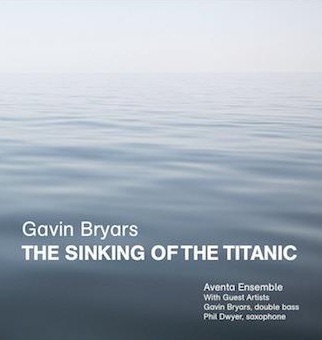
The Sinking of the Titanic

Who: Aventa
Bill Linwood, conductor
Where: Phillip T Young Recital Hall
When: Sept. 18, 2005

By Deryk Barker
Times Colonist staff

At the British enquiry into the Titanic disaster, Steward Edward Brown was asked how long he heard the band playing as the ship foundered. "I do not remember hearing them stop," was his reply.

In the late 1960s Gavin Bryars took this as the starting point for The Sinking of the Titanic, a work of "indeterminate" instrumentation and indeed duration. Although, clearly, the music would have stopped as soon as the instruments were submerged, "on a poetic level, however, the music, once generated in water, would continue to reverberate for long periods of time in the more sound-efficient medium of water and the music would descend with the ship to the ocean bed and remain there, repeating over and over until the ship returns to the surface and the sounds re-emerge."

Aventa's performance of Titanic on Sunday evening began with a barrage of cataclysmic percussive effects: the collision with the iceberg may have felt like a gentle bump to the passengers, but to the crew working in the depths of the ship it probably seemed like - and, in a sense, was - the end of the world.

But Titanic makes its powerful effect quietly and over time; Sunday's performance was no exception. Gradually the repeated and increasingly fragmented hymn tune "Autumn", the recorded voices of survivors, the electronically-treated pre-recorded versions of the hymn, combined to engulf the listener in Bryars' unsettling sound world.

At the close there followed perhaps the longest silence I have ever witnessed in a Victoria concert hall. A testament to the power of the music and its performance.

The first half of the programme was comprised of three shorter pieces by Canadian composers.

Christopher Butterfield's Empress of Russia opened the evening with a bang: with its motor rhythms, terrific momentum and a minimum of gimmicks, it made its point and then stopped. Would that all contemporary composers possessed similar self-restraint.

Leisure 2 by Alison Cameron was a slow-moving work, with constantly-changing and multi-hued textures. The entire work sounded as if it was always ending, yet so tight was the control of the orchestration and so fascinating the individual textures, that it never threatened to outstay its welcome.

If Leisure 2 was an essentially gentle work, there was considerably more - what? - anguish, perhaps, in Rodney Sharman's In Praise of Shadows, receiving its Canadian premiere.

While the instrumentation - including electric guitar, bass guitar, and a battery of percussion - promised, and at times delivered, some quite overwhelming sonorities, there was also much to enjoy in the quieter, if not necessarily gentler, passages.

The composer, who was present, seemed well pleased with the performance.

Another eventful Aventa evening.

The Music of Ligeti

Who: Aventa
Darnell Linwood, horn
John Lowry, violin
Miranda Wong, piano
Yariv Aloni, viola
Bill Linwood, percussion
Where: Phillip T Young Recital Hall
When: May 20

By Deryk Barker
Times Colonist staff

According to the pianist Alfred Brendel, "you need three or five hands to play Ligeti."

Brendel was referring to Ligeti's solo piano music, but I have no doubt that Darnell Linwood, John Lowry and Miranda Wong, who closed Friday's Aventa concert with a spectacular performance of Ligeti's Trio for Violin, Horn and Piano, would agree that the composer does not allow mere human limitations to interfere with his compositional process.

Dubbed "Hommage a` Brahms" and opening with what Ligeti calls a "false quotation" from Beethoven's Les Adieux (which I'm afraid got by me before I could catch it), Ligeti's trio is a monumental and eclectic work. The two quick inner movements had enormous energy: in particular, one could almost have deduced the tempo indication (vivacissimo molto ritmico) of the second movement from the performance, in which Lowry and Linwood wove flights of fancy over Wong's motoric, almost boogie-woogie-style piano.

It was perhaps the final movement which left the most profound impression. The music is slow and intensely felt, and the composer takes advantage of the difference between the equal-temperament tuning of the piano and the overtone-restricted tuning of the horn - and the violinist's dilemma at being caught between this particular Scylla and Charybdis. The resulting sonorities were unearthly, strangely beautiful and completely indescribable.

It is a cliche?L that modern music "simply" needs a good performance to convince. Cliche?Ls often have a kernel of truth, however, and Friday's performance of the Ligeti was a textbook example: so much more than merely getting the notes right (a considerable challenge in itself), it was a truly musical and utterly persuasive performance.

The Danish composer Hans Abrahamsen composed his Six Pieces for Violin, Horn and Piano as a companion piece for the first Danish performance of the Ligeti. Although he does not say so in as many words, Abrahamsen seems to have composed his trio to complement rather than compete with the older work.

While essentially a gentler work than the Ligeti, the Abrahamsen still had its moments of pure excitement, such as the fifth piece, Scherzo misterioso, an increasingly frantic moto perpetuo. The abiding memory, though, is likely to be of the final For the Children, with its quiet exploration of the extremes of the instruments' ranges.

Once again, the music was superbly performed.

Yariv Aloni and Bill Linwood opened the evening with Michael Colgrass's Variations for Four Drums and Viola, composed in 1957 and the earliest music on offer.

Although I've not come across this work before, it has apparently established itself as something of a modern classic with violists - and it is easy to understand why: Colgrass writes well for both players, with some exquisitely elegiac melodic material for the viola and a succession of rhythmic patterns, syncopated, angular and decidedly tricky.

All of this, needless to say, was played with accuracy, style and boundless enthusiasm.

This was undoubtedly an evening for those who believe that they dislike modern music and that it has nothing to say to them; unfortunately, I suspect few actually attended.


Back to top